

What is PCM?
PCM (Press Compression Molding) is a closed-mold composite manufacturing process in which continuous-fiber prepreg is rapidly cured under high pressure in heated steel matched molds using a hydraulic press.
The process uses B-stage prepreg materials that are pre-impregnated with resin. Unlike liquid molding processes such as RTM or LRTM, no additional resin injection or infusion is required during the molding process.
What Can Shuangyi Manufacture Using PCM?
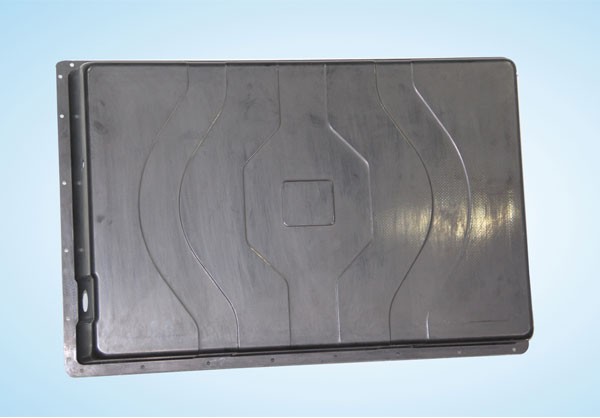
Shuangyi Technology currently applies PCM primarily to the manufacturing of upper covers for battery enclosures used in new energy vehicles.
The process uses large-scale hydraulic presses for high-pressure compression molding, enabling rapid cycle times. The production process features a high level of automation, resulting in consistent product quality and dimensional stability.
Representative PCM Products?
Representative PCM products include multiple upper covers for battery enclosures used in new energy vehicles. These products are available in different models and dimensions and are manufactured using the PCM process.
The components are designed to meet flame-retardancy requirements and are already in volume production for new energy vehicle applications.
PCM Manufacturing Capabilities?
Shuangyi Technology has a dedicated engineering and design team with hands-on experience managing projects across different composite manufacturing processes. This cross-process expertise enables our engineers to develop a strong understanding of product requirements and manufacturing considerations.
Our manufacturing facilities are equipped with multiple hydraulic presses in different capacities, including 1,500-ton, 2,500-ton, and 4,000-ton presses, allowing us to select the appropriate equipment based on product specifications and production requirements.
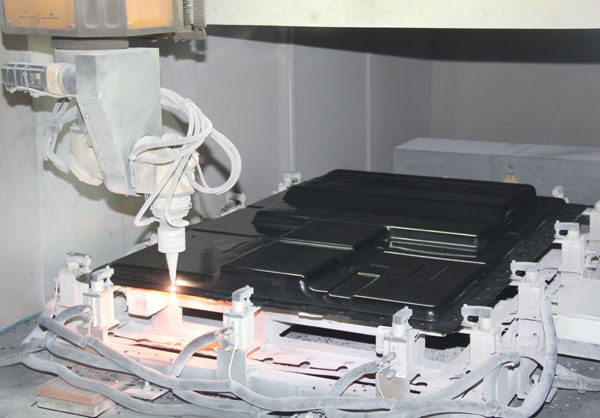
We also operate dedicated laser cutting equipment for PCM components, enabling precise hole cutting and edge trimming. This helps maintain consistent dimensions, accurate part geometry, and stable product quality throughout production.
When Is LRTM Suitable?
PCM is a suitable choice when a product requires lightweight construction, a cycle time of less than 10 minutes per part, high production volumes, and stable, consistent quality.
Typical PCM compression molding cycles are approximately 5–10 minutes per part, while subsequent hole cutting can generally be completed in less than 5 minutes per part.
With its rapid processing cycle, high level of automation, and consistent part quality, PCM is particularly well suited for high-volume production.
PCM Applications
Our engineering team begins each project by gaining a clear understanding of the customer's technical requirements, application conditions, and production objectives. Based on these requirements, we develop and review the product drawings and engineering design, while working closely with the customer to confirm key specifications and details.
The project then moves into first-article production, where the initial part is manufactured and evaluated against the agreed requirements. This stage provides an opportunity to verify the design, manufacturing process, dimensions, and overall product performance before proceeding further.
Once the first article is approved, we move to pilot production, producing a small batch of parts for further validation. Adjustments and refinements can be made during both the first-article and pilot-production stages based on customer feedback and actual production results.
After the product and process have been fully reviewed and approved, the project proceeds to full-scale production. This structured approach helps ensure that the final product meets the customer's requirements before entering volume manufacturing.
Related Products
https://www.shuangyitec.com/?list_18/61.html
Quality Assurance&Testing
Shuangyi Technology has dedicated R&D, engineering, production, and product quality teams. Our quality team uses professional testing equipment to inspect materials and products throughout the manufacturing process, starting with incoming raw material inspection.
Key material parameters, including glass transition temperature (Tg) and other relevant properties, are tested to ensure materials meet specified requirements.
Our quality professionals are experienced in applying established quality management methodologies, including APQP (Advanced Product Quality Planning), PDCA (Plan-Do-Check-Act), and 8D problem-solving.
This enables us to communicate with customers using industry-standard quality terminology and methodologies, supporting efficient technical communication, problem-solving, and quality management throughout the project.
Talk to Our Engineers
Our professional engineers have extensive experience managing composite development projects and leading engineering teams. If you have a custom composite design, engineering, or product development project, our experienced engineering team is ready to work with you to understand your requirements and develop the right solution.
Contact our engineering team:
Tec@shuangyitec.com