

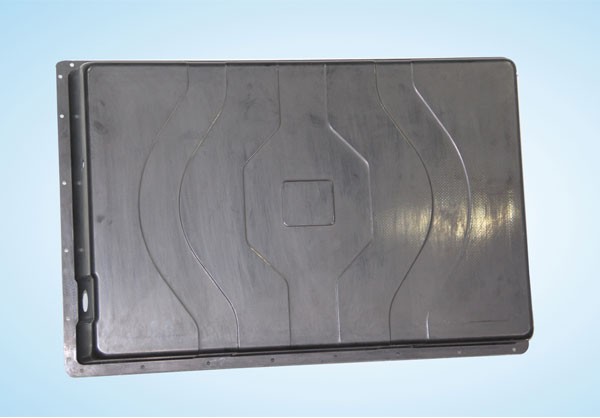
Prepreg Compression Molding (PCM) is a closed-mold composite manufacturing process that uses pre-impregnated fiber materials, known as B-stage prepregs, to produce lightweight, high-strength composite components.
During the process, continuous-fiber prepregs are placed into heated steel matched molds and consolidated under controlled pressure using a hydraulic press. Heat and pressure activate the resin curing process, forming a finished composite component with consistent dimensions and mechanical properties.
Unlike liquid resin molding processes such as RTM and LRTM, PCM does not require additional resin injection or infusion during molding. This makes it particularly suitable for manufacturing lightweight composite components in medium- to high-volume production.
Shuangyi Technology specializes in the customized manufacturing of PCM composite components, with a primary focus on upper covers for new energy vehicle battery enclosures.
Our PCM manufacturing capabilities support the development and production of battery enclosure covers in different sizes, structures and specifications, based on customer drawings and application requirements.
These components are designed to meet specific requirements for:
Lightweight construction
Mechanical strength and structural performance
Flame retardancy
Dimensional accuracy and consistency
Production efficiency and repeatability
Our engineering team works with customers from initial design evaluation and process planning through prototype development, product validation and volume production.
One representative application of our PCM technology is the lightweight upper cover for new energy vehicle battery enclosures.
A representative product has the following technical characteristics:
Product thickness: 1.2 mm
Product weight: 4.4 kg
Overall dimensions: 1,380 × 908 × 204 mm
Airtightness test pressure: 5 kPa
Reported mechanical test results include:
Tensile strength: 467 MPa
Tensile modulus: 24.5 GPa
Flexural strength: 688 MPa
Flexural modulus: 25.7 GPa
The product has also been evaluated for flame-retardant performance, with V-0 classification reported under the applicable vertical combustion test standard.
These figures represent a specific PCM product and its reported test results. Actual specifications and performance requirements vary depending on product design, materials and customer requirements.
Shuangyi Technology combines composite engineering experience, dedicated production equipment and automated manufacturing processes to support customized PCM component development and production.
Our manufacturing facilities are equipped with hydraulic presses in different capacities:
1,500-ton hydraulic press
2,500-ton hydraulic press
4,000-ton hydraulic press
This range of equipment allows us to select suitable molding conditions based on component dimensions, structural design, material characteristics and production requirements.
We operate dedicated laser cutting equipment for PCM components, enabling accurate hole cutting and edge trimming after molding.
This secondary processing capability helps achieve consistent component geometry, accurate hole positioning and dimensional stability.
Our engineering team has experience in composite product development and multiple manufacturing processes. This cross-process knowledge helps us evaluate product structures, material selection, tooling requirements and manufacturing feasibility before production.
From initial engineering evaluation to production process optimization, we work closely with customers to develop practical manufacturing solutions.
PCM is particularly suitable for composite components that require lightweight construction, high dimensional consistency and efficient production cycles.
It is a strong manufacturing option when projects involve:
Continuous-fiber composite materials
Thin-walled or lightweight structural components
High requirements for mechanical performance
Flame-retardant material systems
Medium- to high-volume production
Consistent product quality and repeatable manufacturing
Typical PCM molding cycles at Shuangyi are approximately 5–10 minutes per part, depending on product design, material system and process conditions.
Subsequent laser cutting and hole processing can generally be completed in less than 5 minutes per part.
The combination of rapid compression molding and automated secondary processing makes PCM suitable for automotive and new energy vehicle applications where production efficiency and product consistency are important.
At Shuangyi Technology, every customized PCM project begins with a detailed understanding of the customer's product requirements and application conditions.
Our development process typically includes the following stages:
1. Customer Requirements and Engineering Review
We review customer drawings, product specifications, structural requirements, application conditions and expected production volumes.
2. Product Design and Process Evaluation
Our engineering team evaluates product geometry, material selection, tooling requirements and PCM manufacturing feasibility. Engineering recommendations are provided to improve product performance and manufacturability.
3. First-Article Production
An initial prototype is manufactured to verify the product design, dimensions, manufacturing process and agreed technical requirements.
4. Product Validation and Design Optimization
The first article is evaluated against customer requirements. Necessary design or process adjustments are made based on inspection results and customer feedback.
5. Pilot Production
A small production batch is manufactured to evaluate process stability, product consistency and production readiness.
6. Mass Production
Following customer approval and process validation, the project moves into volume production with established manufacturing and quality control procedures.
This structured development process helps reduce manufacturing risks and supports a smooth transition from customized product development to stable production.
Quality control is integrated throughout Shuangyi Technology's composite manufacturing process, from incoming material inspection to finished product evaluation.
Our quality assurance capabilities include:
Incoming raw material inspection
Material property verification, including glass transition temperature (Tg) testing
Product dimensional and visual inspection
Process monitoring and production quality control
Product performance verification according to project requirements
Our quality teams apply established quality management methodologies, including:
APQP (Advanced Product Quality Planning)
PDCA (Plan-Do-Check-Act)
8D problem-solving methodology
These practices support systematic quality planning, process improvement and effective communication with customers throughout product development and manufacturing.
Shuangyi Technology has developed and manufactured multiple PCM battery enclosure upper covers for new energy vehicle applications.
These customized components involve different product models and dimensional specifications, requiring engineering evaluation, dedicated tooling development and controlled compression molding processes.
The project demonstrates our ability to integrate:
Composite material and product engineering
PCM tooling and process development
Large-tonnage hydraulic compression molding
Laser cutting and precision edge trimming
Product inspection and quality management
Prototype development and volume production
Through the combination of engineering expertise and dedicated manufacturing equipment, Shuangyi supports customers in developing lightweight composite battery enclosure components for new energy vehicles.
1. What products can be manufactured using PCM?
PCM is suitable for manufacturing lightweight, continuous-fiber composite components. At Shuangyi Technology, its primary application is upper covers for new energy vehicle battery enclosures.
2. What hydraulic press capacities are available at Shuangyi Technology?
Our PCM production facilities are equipped with 1,500-ton, 2,500-ton and 4,000-ton hydraulic presses.
3. How long does the PCM manufacturing process take?
Typical molding cycles are approximately 5–10 minutes per part. Secondary laser cutting and hole processing generally take less than 5 minutes per part. Actual cycle times depend on product design and process requirements.
4. Can Shuangyi develop customized PCM components based on customer drawings?
Yes. Our engineering team supports customized product development, including design evaluation, manufacturing feasibility assessment, tooling development, prototype production and process optimization.
5. Does Shuangyi support prototype development and mass production?
Yes. We support first-article production, pilot production and subsequent volume manufacturing following product validation and customer approval.
6. What quality management methods are used in PCM production?
Our quality teams apply APQP, PDCA and 8D methodologies, together with material inspection and product quality verification.
7. What materials are used in PCM composite manufacturing?
PCM manufacturing typically uses continuous-fiber-reinforced epoxy prepregs, in which the resin is partially cured to a B-stage condition before molding. Depending on product design and performance requirements, glass fiber or carbon fiber prepregs may be selected.
At Shuangyi Technology, the prepreg materials are cut according to programmed patterns, laid into heated matched steel molds, and consolidated under controlled temperature and pressure using hydraulic presses. After molding, the components undergo laser cutting and edge finishing to achieve the required dimensions and geometry.
8. Can PCM battery enclosure covers be customized for different EV models?
Yes. PCM-processed battery enclosures are fully customized to client requirements. Customers may provide detailed performance specifications, or we can develop designs based on supplied drawings. Our engineers will work closely with clients to review product performance targets and feasible implementation plans, followed by first article trial production.
9. How does Shuangyi verify the quality and performance of PCM components?
Shuangyi Technology implements quality verification throughout the PCM manufacturing process, beginning with incoming inspection of fiber-reinforced epoxy prepreg materials.
In-process inspections cover material lay-up, compression molding, trimming and other key manufacturing stages. Depending on customer specifications and project requirements, product verification may include dimensional inspection, mechanical property testing, flame-retardant performance evaluation and airtightness testing.
We implement first-article inspection and batch sampling, maintain inspection records and provide relevant test reports to support product traceability and customer quality requirements.
Q10. What production volumes can Shuangyi support for PCM battery enclosure covers?
Shuangyi Technology supports both low-volume prototype development and high-volume serial production of PCM battery enclosure covers. Production schedules are arranged according to customer demand, product specifications and project requirements.
We have supplied PCM battery enclosure upper covers for Great Wall Motors, with a reported monthly production capacity of approximately 10,000 units for the relevant product program. This experience demonstrates our ability to support customized product development and stable volume production.
Customers are welcome to share their annual demand forecasts so that our team can evaluate production capacity, tooling requirements and delivery schedules for their projects.
PCM vs. Other Composite Manufacturing Processes
PCM differs from liquid resin molding processes such as RTM and LRTM in its material preparation and molding method.
PCM uses pre-impregnated continuous-fiber materials that are consolidated and cured in heated matched molds under controlled pressure. RTM and LRTM, in contrast, use dry fiber reinforcement into which liquid resin is injected or transferred during molding.
PCM is particularly suitable for applications requiring lightweight structures, consistent dimensions and efficient production cycles using prepreg materials. The most suitable process depends on product geometry, performance requirements, material selection and expected production volumes.
Talk to Our Engineers
Looking for a manufacturing partner for customized PCM composite components?
Shuangyi Technology provides engineering support, tooling development and PCM manufacturing solutions for new energy vehicle battery enclosure covers and other customized composite applications.
Our engineering team is ready to discuss your product drawings, technical requirements and manufacturing objectives.
Contact our engineering team:
export@shuangyitec.com