

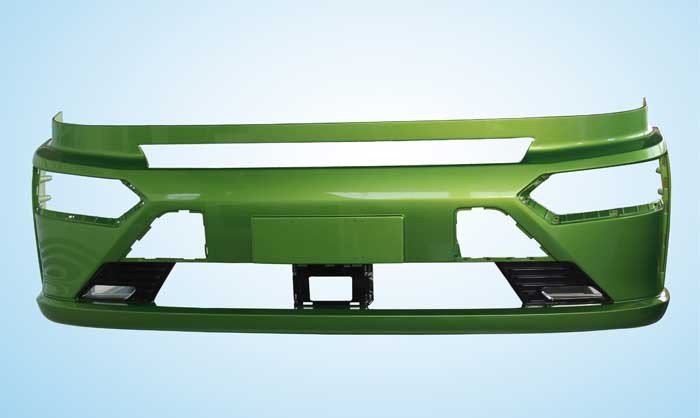
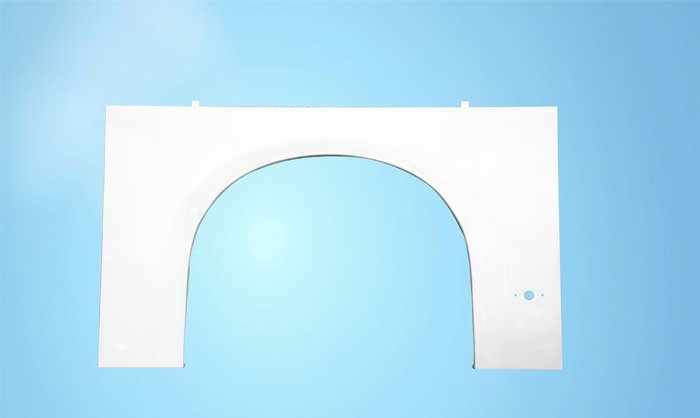
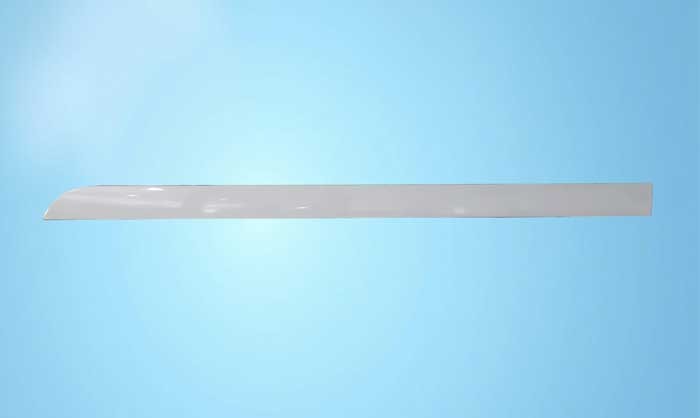
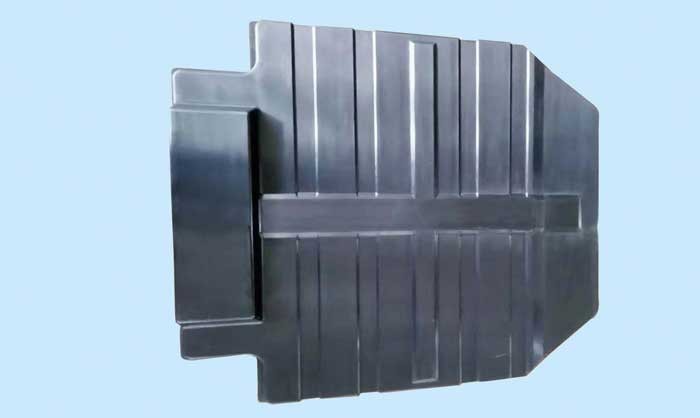
Shuangyi Technology has supplied SMC-molded components to leading manufacturers such as Yutong Bus and XCMG Group. Our SMC product portfolio covers a wide range of automotive and commercial vehicle applications, including wheel arch panels, bus front panels, headlamp covers, left- and right-hand headlamp bezels, upper battery enclosures, and engine covers for construction machinery.
These products demonstrate our capabilities in manufacturing customized SMC components for commercial vehicles, new energy vehicles, and construction equipment.
Why Choose SMC? Advantages Over Other Manufacturing Processes
SMC offers relatively short molding cycles, with individual components typically molded in approximately 10 minutes or less. Precision laser trimming ensures accurate edge finishing and consistent product dimensions, helping maintain dimensional accuracy and manufacturing consistency across production batches. SMC components also offer good flame-retardant properties.
Shuangyi Technology has supplied a range of SMC-molded components in multiple specifications to leading manufacturers, including Yutong Bus and XCMG Group. These customized components help reduce vehicle weight while meeting the performance and application requirements of commercial vehicles and construction machinery.
Shuangyi Technology operates multiple SMC compression molding presses with capacities of 1,000, 2,500, and 4,000 tons. We provide customized SMC components tailored to customer requirements, supporting the entire production process from first-article trials and small-batch production to full-scale mass production and delivery.
Shuangyi Technology currently manufactures at least 150,000 SMC components annually, demonstrating our proven production capacity and ability to support large-volume customer programs.
We provide customized engineering design solutions based on each customer's specific requirements. Using professional Finite Element Analysis (FEA) software, we simulate and evaluate how products respond to different loads and operating conditions in various application scenarios.
Based on these simulations, we prepare detailed engineering analysis reports and discuss the findings with our customers. By using data-driven analysis to guide technical discussions, we work through multiple rounds of communication and simulation testing to establish a preliminary design concept.
Once the initial concept is established, we move into detailed engineering design. Each component is individually developed to address its specific structural and load-bearing requirements.
We work closely with customers to understand their application needs, resolve structural challenges and confirm every critical design detail. Upon completion, we generate detailed 2D engineering drawings and 3D CAD models for customer review and approval.
Following drawing approval, we proceed with first-article prototyping.
This stage is not simply about producing a finished sample. It is a critical step in validating the engineering design under actual manufacturing conditions. Initial prototypes are evaluated, and design adjustments are often made to address issues identified during the trial process.
Once the first article is completed, the customer conducts its own trial production using the prototype and provides feedback on the results.
Based on the customer's feedback and actual production performance, we further refine the design to better meet the customer's requirements.
After multiple rounds of technical discussions, design modifications and customer approval, the project moves into small-batch production.
At this stage, we manufacture a limited quantity of components using the optimized design. The customer then conducts further testing and validation to verify the product's performance, manufacturability and suitability for the intended application.
Successful small-batch validation provides the basis for final design confirmation and the transition to mass production.
Following successful small-batch validation, the project enters mass production and delivery.
However, our engineering support does not stop once mass production begins. We continue to work with customers to make customized adjustments and optimize product designs and manufacturing processes in response to changing requirements and actual operating conditions.
Through ongoing communication and continuous improvement, we ensure that our products remain aligned with customers' specific applications and evolving needs.
From initial concept and engineering analysis to prototype validation, small-batch trials and mass production, Shuangyi Technology provides end-to-end customized engineering and manufacturing solutions.
Shuangyi Technology has extensive experience in a wide range of composite manufacturing processes, including SMC, PCM, P-DCPD, LFT-D, LFI, Autoclave, VARI, HP-RTM and LRTM.
Rather than relying on a single manufacturing process, we leverage our expertise across these technologies to develop the most suitable solutions for each customer's specific requirements.
When evaluating a project, we consider multiple factors, including product complexity, structural performance, production volume, delivery lead time and weight requirements. Based on these factors, our engineering team evaluates different manufacturing options and recommends an optimized process solution tailored to the application.
For example, when a customer requires a component with significantly improved structural strength while achieving a weight reduction of more than 30%, we may evaluate processes such as SMC, PCM and HP-RTM to determine the most appropriate solution.
In some applications, a single manufacturing process may not be sufficient to meet all performance and production requirements. In such cases, we can combine or integrate different composite manufacturing processes within the same product development program to achieve the desired results.
Our strength lies not simply in mastering multiple composite manufacturing technologies, but in knowing how to select, adapt and combine them to solve complex engineering challenges and deliver customized solutions that meet our customers' specific requirements.
Scalable Production & Delivery Capabilities
Shuangyi Technology operates multiple hydraulic presses with capacities of 1,000, 1,500, 2,500 and 4,000 tons, supported by multiple laser cutting machines and dedicated tooling and forming equipment.
Based on each customer's product specifications and production requirements, we can select the appropriate press capacity and configure the manufacturing process accordingly, ensuring efficient and reliable production.
With our established equipment infrastructure and manufacturing capabilities, our current annual production capacity for lightweight composite components reaches 200,000 units.
Our flexible production setup enables us to support a wide range of customer requirements, from initial production trials and small-batch manufacturing to large-scale production and consistent delivery.
Design Challenges & Solutions
At the initial design stage, we work closely with customers to fully understand their requirements, ensuring that the mold design is carefully developed, reviewed, and refined through detailed technical discussions.
During production, we utilize multiple compression molding presses with different tonnage capacities, allowing us to accommodate a wide range of product specifications and customized manufacturing requirements.